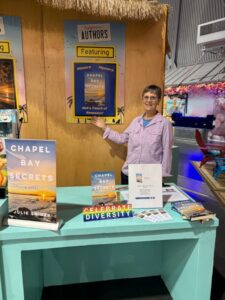


Chapel Bay Secrets is a small-town mystery with a lesbian protagonist navigating family secrets, fighting a book ban, and exploring the legacy of Japanese American incarceration in a coastal California community.
Brenda Kato, a Japanese American lesbian librarian seeks the father she’s never known and is hit with a book ban, sending her into a panic. Her mother’s time in a Japanese internment camp continues to haunt her, coloring decisions she makes in the present.
No longer with the love of her life, she’s forced to rely upon two strangers —- a wealthy widow with literary aspirations and a retired psychologist with a guilty secret. When a nefarious local author enters their lives intent upon blackmail, the stakes are higher yet. A beautiful blonde runner enters Brenda’s life, and she wonders if she can learn to love again.
Can Brenda find the truth about herself and support her community while finding love once more?
Julie Snider
Chapel Bay Secrets, opening scenesPage Settings
Look Inside the Book
Chapel Bay Secrets, opening scenes
Brenda Kato’s stomach churned. Bile rose in her throat.
The street outside her window, so noisy just
moments ago, was as quiet as the library stacks on the
other side of her door. Her heart pounded in the vacuum of
READ MOREsound, a pain growing as the pressure rose in her chest. She shook
her head and blinked, then scooted her chair far back, away from
the vile words on the computer screen.
From: Lovers of Literature
To: Brenda Kato, Chapel Bay Library
Re: Author Events/Inappropriate Books
Date: November 18, 2022
Dear Ms. Kato:
As the person in charge of the Meet the
Author events for the Chapel Bay Library, it is
your responsibility to make certain that
authors and books featured are of a HIGH
MORAL CALIBER. In these uncertain and
morally ambiguous times, our families—
especially the children—are in great need of
protection from corrupt, harmful, Un-American
sentiments. We have noticed that several of
your recently featured selections veer toward
what we can only describe as dangerous. The
threat to our way of life is serious. America is
and always has been a nation of believers. But
many among us are hell-bent on taking the
truth out of our schools and libraries.
We, the Lovers of Literature, are here to guide
you toward a more moderate and sensible set
of offerings to the public. Below, you will find
a list of objectionable titles, authors, and
topics.
The list was extensive. Topics included LGBTQ themes
and authors, tomes concerning Jewish, Muslim, and atheist
people, books written by and about Black and Brown people in
America and—here it was—Asian American stories, including
those about Japanese incarceration. Stories about people such as
her own mother, Toshi. Put into an internment camp in this state,
California. On the so-called “left coast.”
She felt a full-blown panic attack approaching.
Stop.
Breathe.
Counting to twenty as she slowly inhaled, then exhaled, she
pulled herself back from the abyss.
***
This brightly lit Tuesday in November had started like
most other days in the idyllic town of Chapel Bay. Brenda had
eaten breakfast—oatmeal with raisins and one slice of wheat toast
—then strolled downhill from her blue bungalow to the town’s
library. Her street was quiet, especially before nine a.m., and she’d
felt a calmness settle into her bones as she walked.
Entering the library, she’d removed her sunglasses. As her eyes
adjusted to the muted indoor lighting, she’d gazed across the
expanse of grey marble floor toward a round oak table just to the
left of the circulation desk. The table displayed new acquisitions,
behind which stood a light brown three-panel display board. The
words, “It’s Autumn: Time to Fall for a New Book” blazed across
the board in bright orange script.
As Brenda watched, a mother and her elementary-aged son
inspected an LGBTQ-themed chapter book. The boy’s dark eyes
sparkled; he clutched the volume to his chest. Brenda’s heart
swelled with pride, and she wiggled the fingers of her left hand in
a little wave as the two walked toward the circulation desk. She
had waited for this moment, hoped for it, since taking the posi‐
tion of library events and acquisitions coordinator in Chapel Bay.
That was three years ago. It felt good to see that the diversity ball
was rolling, that her hard work was finally paying off.
Still feeling the afterglow, Brenda had walked the short
distance down the hallway to her office. Her Nikes squeaked on
the recently polished floor, and she’d made a mental note to ask
the custodian to go a little lighter with the wax next time.
Opening the door, she glanced at the cluttered but cozy work‐
space. File folders of research material and partially read books sat
on chairs and atop file cabinets, yet the small Turkish rug in the
center of the room brought warmth and charm to the relative
chaos. Green, round-framed reading glasses planted on her nose,
she’d sat down in her swivel desk chair to prepare for the Meet the
Author event taking place in two weeks. In short order, she had a
ton of details to nail down. At a minimum, emails needed to be
sent to hopeful attendees, flyers picked up from the printer and
posted, and catering decisions made. Would the usual coffee and
cookies suffice, or should she spruce things up with cucumber
sandwiches? Would enough volunteers arrive to set up, serve, and
clean up?
At 53, Brenda had done her fair share of grunt work. As much
as she enjoyed micromanaging, she’d leave last-minute details to
the volunteer coordinator. Brenda was the show runner. She
would need to be in full babysitting mode on the big night,
ensuring the speaker’s tie was straight, his water glass full, and that
he’d be at the podium promptly at seven p.m., ready to speak. A
sudden bout of stage fright had overtaken last month’s speaker,
and the one before had a coughing fit in the middle of her talk.
Postponing the complexities of planning, Brenda had taken a
swig of water from her NPR flask and moved on to the less taxing
job of reading emails. Her inbox held the usual array of clutter.
Then she’d discovered the email that wiped away her feelings of
self-satisfaction, sending her into a dark and lonely place.
The email ended with a threat:
Be warned that attempts to glorify these
‘woke’ authors and their books will result in
protests and possible other actions.
Possible other actions? Like what? Never mind that the last
sentence was not grammatically correct.
Thoughts about a recent news article flooded her mind.
What did it say, again? Brenda took a sip of water, and the gist of
the article came back to her. Several community members in
Southern California had protested the local library’s LGBTQ
display during Pride Month. They defaced the display, checked
out every book related to LGBTQ people, and never returned
them.
Shit!
Shaking with anger, Brenda closed the email and thought
about deleting it. She paused, hand hovering above the trash can
symbol. This needs investigating. She forwarded it to Justin, the
head librarian, with a request that he ask the IT department to do
forensic research, hoping to learn the origins of the hate mail.
After some deep breathing and a walk around the block, Brenda
actually got some work done. But her heart continued its rapid
beating.
Hours later, she snapped her laptop shut and stretched her
neck.
How is it already after four p.m.? Her neck and back popped,
reminding her it was high time to go for her run. As she rose from
her chair, pulling her whole body to a vertical position, April, the
volunteer coordinator, called out.
“Hey there, Brenda! I got your note about volunteers. I’ll call
the five folks who’ve offered to arrive early on Friday for setup. I
still need to nail down my cleanup crew.”
“Okay, great, thanks. I couldn’t do this job without you!”
“Well, looks like you’re heading out for the day, so talk later?”
“Okay, see ya tomorrow,” Brenda said as she put first one arm
and then the other into her wool sweater.
Brenda rose and strolled out of the library. Walking uphill, she
passed Chapel Bay’s new tea shop and bed-and-breakfast, gables
and turrets wearing a new coat of paint. The irony of the town’s
ambience never failed to bring a smile. The ‘good old days’ in this
coastal tourist town, midway between San Francisco and San Luis
Obispo, seemed more real than Brenda’s memories of growing up
in Sacramento forty years ago. A vibrant, upscale version of the
nineteenth century, sanitized for one’s protection. When storms
took out the electricity and Wi-Fi, tourists fled quaint Chapel Bay
and sought twenty-first century conveniences inland.
As she rounded the corner, the moist air hit her face and
seeped into her lungs. Picking up her pace a bit, Brenda couldn’t
wait to get back to her cottage and put on her leggings, running
top, and shoes. She needed to get going. Fog could roll in at any
time.
As she opened the front door, Brenda was already planning
her run. The marathon was twenty-six days away, and next
Sunday’s half marathon would be a kind of tune-up. Today, a
tempo run—nothing hard. A moderate seven miler would work
fine. Two chilled water bottles nestled into her running belt, she
headed out the door for her daily dose of freedom. Cap donned,
she stopped to select the run mode on her Garmin watch and
began her warm-up mile. Two neighbors waved from their front
yards, and she nodded, but kept moving with her goal in mind.
Today’s run felt especially liberating. The day’s tension melted
away as muscles warmed and expanded. Thoughts about the
hateful email receded. At her turnaround point just beyond the
wharf, Brenda stopped for a long drink. She wasn’t looking for
perfection. Wear and tear were par for the course. Sore knees,
plantar fasciitis, the list went on. Brenda’s body carried the scars
and stars of the spills and thrills she had taken over the many miles
she’d covered. Now, here she was. Middle age was behind her and
old age was still up around the bend. May as well make the most
of this time, as it wouldn’t last forever.
It was easy to speed up on the return trip, as there were rela‐
tively few pedestrians on the path today. Such a nice change, as
the warmer months brought big crowds to Fisherman’s Wharf.
Other than this weekend’s half marathon, November was rela‐
tively quiet by the bay.
Only one more mile to go. Brenda looked down at her
running watch to check her speed. At that exact moment, a dog
appeared directly in her path. What the hell!
“Hey, watch out!” shouted Brenda.
On the other end of the lab’s leash was an older guy, tall and
gaunt, staring off into space, not even looking at his two dogs. Yes,
two! Luckily, the other one was far enough off the path to avoid
what would have been a truly bad tangle.
The old guy whipped his head around and pulled the
wandering pooch out of her way. Why are some people so oblivious
when out with their dogs?
The man muttered something—maybe an apology—but
she’d already gone up the path. Heart pumping, Brenda rounded
the final corner. A dark sedan approached her from behind,
lingering for a minute before speeding past her. Endorphins from
the run weren’t powerful enough to counteract the chill that
crept up Brenda’s spine. The smell of exhaust made her gag, and
for a moment she was afraid she might puke. Heart pounding, she
looked around. Who was that? Why were they following me?
Unfortunately, she’d been unable to get a clear view of the driver.
All she could see was the profile of a male wearing a red ball cap.
Was that the person who’d sent the creepy email?
Ugh.
Pausing at the front door of her house, Brenda felt a rush of
lightheadedness. She placed her hands on her thighs and lowered
her head until the feeling passed. The table lamp in the front
room cast a warm glow through the slight mist. She imagined her
piano inside the house and had a quick twinge of guilt for
neglecting her practicing of late.
As she slipped the key into the lock, Brenda had a quick "ash‐
back to a particular evening in 2010, twelve years earlier. She was a
new runner then, in a new relationship. She couldn’t help but
wish Cynthia was waiting on the other side of the door now, just
as she had been that evening in their San Francisco apartment. She
wondered if Cynthia even thought about her anymore. I should
call her. She always listened when I was scared. But will she answer?
© Julie Snider. Created with Tertulia for Authors
COLLAPSESharon J. Wishnow wrote:Don't let Chapel Bay Secrets' sweet coastal facade fool you--the novel brims with depth and complexity. Snider's protagonists face off with the small minded bigotry that so easily co-exist in a small community, uncover past secrets, embrace their truths, and find that sometimes connection is closer than you think. An uplifting, optimistic novel perfect for these times.
--Jordan Rosenfeld, author of Fallout and The Sound of Story: Developing Voice & Tone in Writing
Readers Favorite on Readers Favorite wrote:Julie Snider’s powerful new novel Chapel Bay Secrets uncovers the hidden struggles of small-town America, where ideas over immigration, book banning, and LGBTQ+ rights hit close to home. Through the lives of three people wrestling with loss, regret, and longing, Snider reveals how healing begins when individuals confront their pasts and rediscover the strength of community.
-- Sharon J. Wishnow author of The Pelican Tide
Chapel Bay Secrets by Julie Snider follows the intersecting lives of Harriet, Brenda, Joe, and Franklin in the small coastal town of Chapel Bay. Harriet, a retired woman with literary ambitions, begins to explore her family’s Italian and English roots after finding her late mother’s keepsakes, discovering secrets that reshape her understanding of her past. Brenda, the town librarian, struggles with both personal identity and the legacy of her Japanese-American family’s incarceration during WWII while facing harassment from a shadowy group opposing inclusive books. Joe, a retired psychologist burdened by guilt over an affair from decades past, seeks redemption and new beginnings, even as Franklin, a manipulative fraudster, threatens to expose his secrets. The novel unfolds across a backdrop of community events, holiday gatherings, and quiet reckonings, weaving themes of belonging, heritage, forgiveness, and resilience. By the end, Chapel Bay becomes not only a place of hidden wounds but also of healing, connection, and new hope. Julie Snider’s Chapel Bay Secrets blends small-town charm with timely urgency, making it both comforting and thought-provoking. The world of Chapel Bay is tangible, with its tea shops, wharf paths, and community events, but it’s the undercurrent of conflict that gives the book its strength. Brenda’s harassment by the so-called Lovers of Literature captures the reality of America’s current debates over censorship and inclusion, showing the emotional toll of being targeted for defending diverse voices. Harriet, with her humor and stubborn warmth, illustrates that rediscovery and growth can happen at any age, while Joe’s quiet struggles with past regrets add gravity to the narrative. The exploration of Japanese-American internment and hidden immigrant histories grounds the story in cultural truth, giving it a resonance beyond Chapel Bay. Snider’s prose is clear and engaging, balancing suspenseful twists with heartfelt moments. Even Franklin, though antagonistic, injects tension that keeps the story moving without overshadowing its deeper themes. The title itself is fitting—every town has its secrets, and here they become a lens for identity, memory, and resilience. With layered storytelling, socially relevant themes, and heartfelt characters, Chapel Bay Secrets earns five stars as a novel that speaks to both the heart and the times. It’s a perfect choice for readers who love contemporary fiction rooted in community, history, and the fight to let every voice be heard.
—Readers’ Favorite Review